Power and Hierarchy: How Safety Is Shaped
Psychological Safety: Research to Practice
Listen here.
Subscribe on Apple Podcasts, Amazon Music & Audible or Spotify!
Or subscribe here for an email with each episode!
The Invisible Architecture of Power
No group is neutral when it comes to power. Titles, roles, experience, and access all affect who feels safe enough to speak, question, or push back, even if no one ever says it out loud.
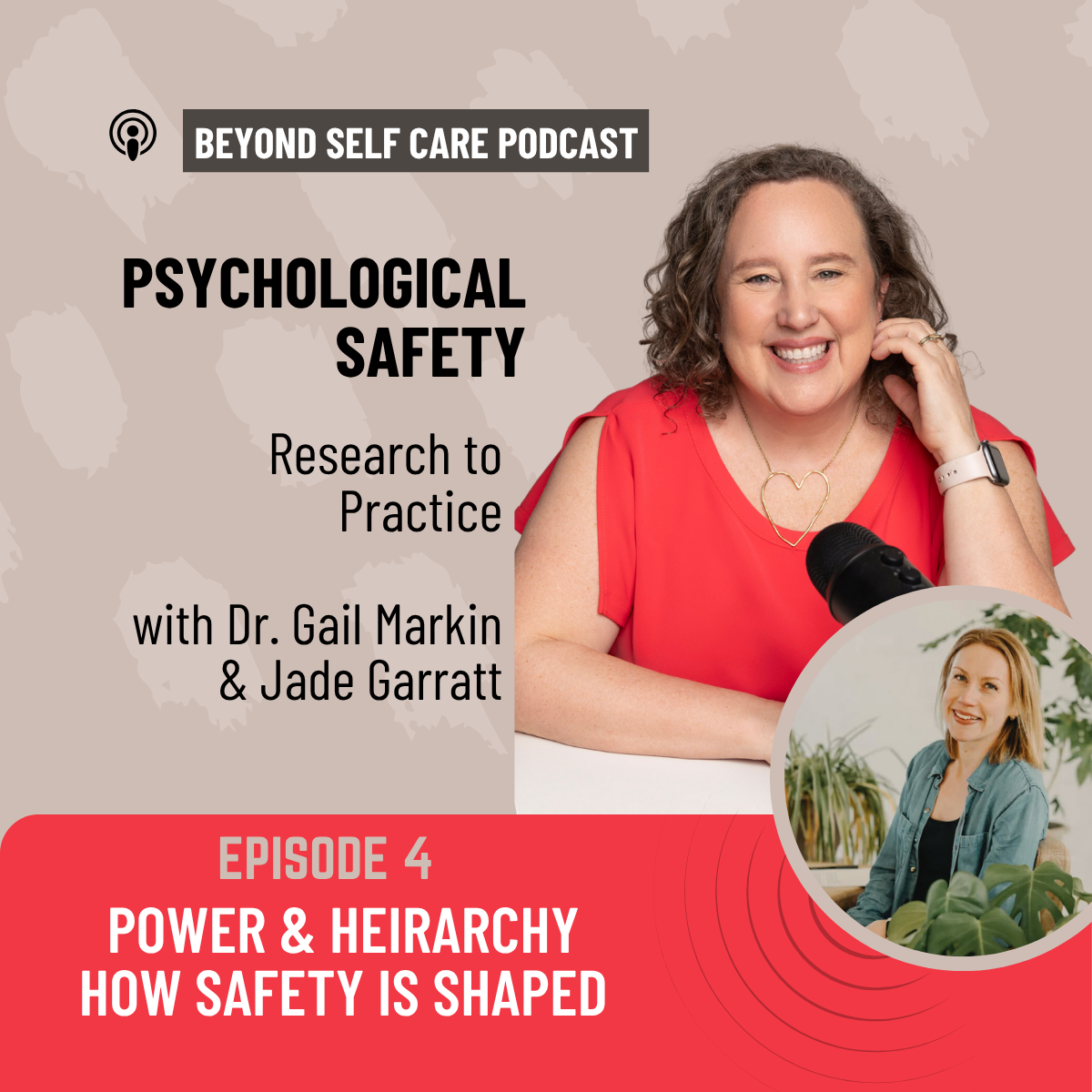
In Episode 4, Gail Markin and co-host Jade Garratt focus directly on how power and hierarchy shape psychological safety. This conversation moves away from individual intention and toward a more structural understanding of why some voices are heard more easily than others. Rather than framing power as inherently negative, this episode explores how power operates in real environments and how unexamined hierarchy can quietly limit openness, learning, and participation.
“Someone moves from a certain role into the next level role… and it’s almost like a magic has occurred...all of a sudden, they have to behave so differently, or they can’t have the same conversations.”
Key Ideas
Power, Hierarchy, and Uneven Risk
Power and hierarchy are always present, shaping who feels safe to speak and who stays cautious. Even when unspoken, roles and status influence whose ideas are welcomed, questioned, or ignored. This episode highlights that risk is not distributed evenly. Speaking up, challenging decisions, or admitting uncertainty can carry very different consequences depending on where someone sits within a hierarchy.
Why Good Intentions Aren’t Enough
Gail and Jade challenge the idea that positive intent alone creates psychological safety. Even well-meaning leaders and facilitators can unintentionally silence others if they overlook how their authority or influence shapes group dynamics. Who speaks first, whose ideas are reinforced, how disagreement is handled, and what happens after a challenge all send powerful signals. These everyday moments teach people what is truly safe, regardless of stated values.
Awareness Changes How Power Is Used
Power becomes more constructive when it is acknowledged rather than denied. When people understand how decisions are made and how disagreement will be received, fear decreases. Psychological safety grows when power is exercised predictably and transparently, reducing the need for constant risk calculation.
“The consequences of us speaking up to that power… can be very real.”
Key Takeaways
Power and hierarchy shape psychological safety in every group.
Risk and consequence are unevenly distributed across roles.
Silence often reflects awareness of hierarchy, not lack of engagement.
Good intentions do not neutralize the impact of authority.
Acknowledging power supports more open participation.
Power language is often embedded in our workplaces and contributes to power differentials
What You Can Do
Name power and roles out loud.
You can name power and roles explicitly by clarifying who holds decision-making authority when inviting input or discussion. For example, say “I’ll be making the final decision, but I genuinely want to hear your thinking first.”
Create cross-role learning opportunities.
When people in different roles learn together in spaces created with psychological safety in mind, it promotes relationships and collective understanding.
Design diverse committees and projects.
Invite people with wisdom and expertise in particular areas to contribute to projects and committees.
Provide opportunities for shared or distributed leadership and decision making.
Consider using distributed leadership models and decision-making models that move decision-making to where knowledge is.
Review institutional practices to confirm they still align with present values.
Many processes, like hiring and advancement processes for example, may be outdated or unclear and would benefit from being restructured to fit with the organization’s intended values.
Watch your language.
Notice and change the power language that doesn’t fit with your intentions.
🎧 Listen to the full episode to explore how power and hierarchy shape who feels safe to speak and learn.
“Unless we’re willing to engage with ideas around power and hierarchy…
I don’t think psychological safety work can ever be that effective.”