Psychological Safety: Research to Practice
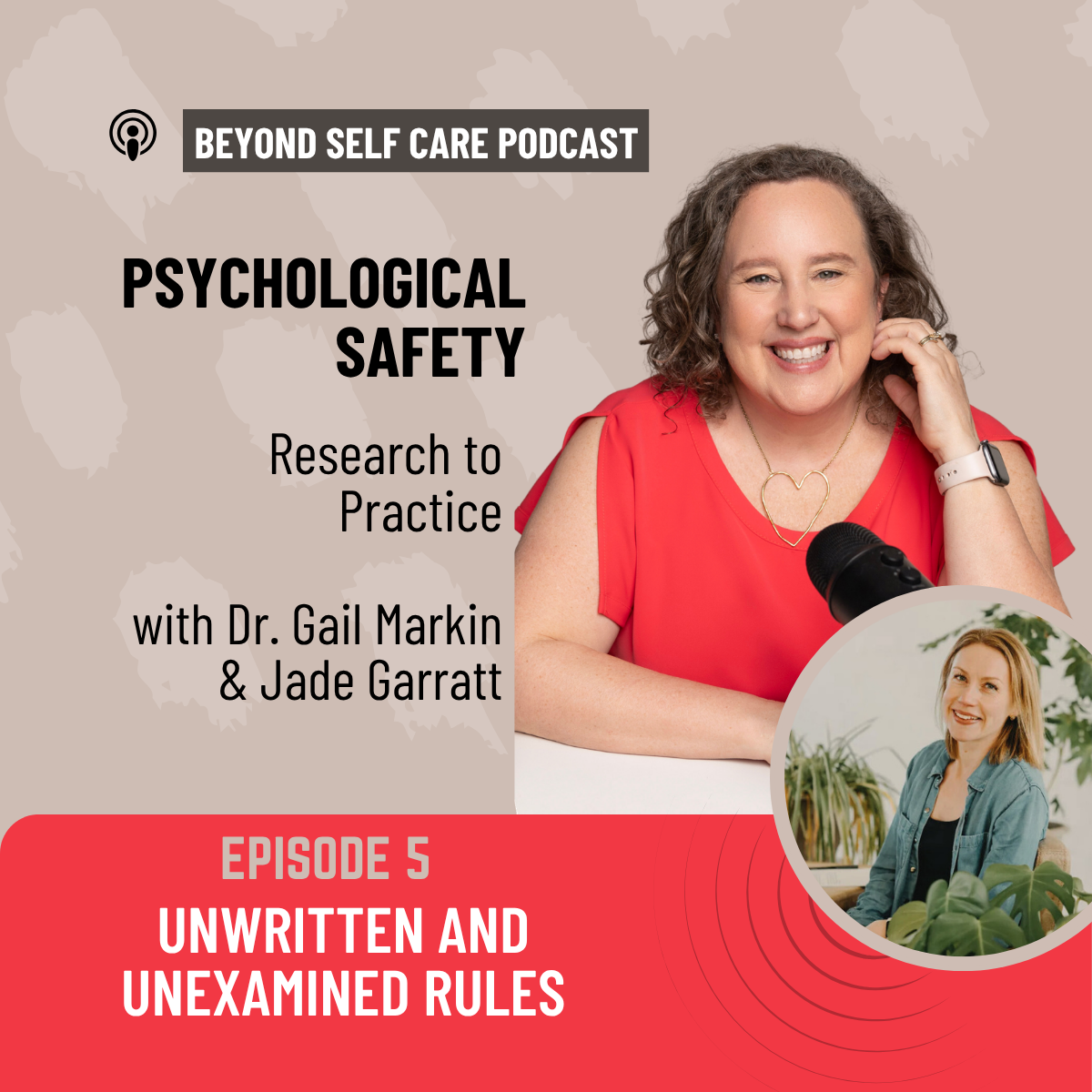
Listen here.
Subscribe on Apple Podcasts, Amazon Music & Audible or Spotify!
Or subscribe here for an email with each episode!
Shaping Voice, Belonging, and Opportunity
Psychological safety is often described in terms of values, behaviours, and leadership practices. But in Episode 5, Gail Markin and Jade Garratt turn attention to something less visible and often more powerful: the unwritten rules that shape how people actually behave. These unwritten rules don’t just shape behaviour, they influence belonging, reputation, and even career trajectory, affecting who feels able to contribute and when.
These rules are rarely documented or discussed directly. Instead, they are learned through experience, observation, and subtle signals about what is rewarded, tolerated, or avoided. Over time, they form a quiet but persistent layer of culture that influences who speaks, who stays silent, and how risk is managed.
This episode explores how unwritten rules develop, how they are reinforced, and why they often override formal intentions around psychological safety. It challenges listeners to look beyond what organizations say they value and instead examine what people are learning through everyday interactions.
Guest Spotlight: Kevin Reimer
Kevin Reimer is a former school principal, leadership coach, and author. He previously served as Executive Director of the British Columbia Principals’ and Vice-Principals’ Association and is the author of A Year of Leading, a 40-week leadership companion grounded in the realities of school leadership.
Kevin brings a practical, experience-based perspective to this conversation, focusing on how people navigate the often unspoken expectations within organizations. His insights highlight how individuals learn to read situations, interpret signals, and adjust their behaviour based on what is reinforced in practice rather than what is formally stated.
“You start to pick up on what’s really going on by watching what happens to other people.”
Key Ideas
Unwritten Rules Often Matter More Than Formal Policies
Unwritten rules shape how people behave on a day-to-day basis, often more powerfully than official policies or stated values. While organizations may communicate openness or psychological safety, people pay closer attention to what actually happens in practice. Over time, these lived experiences form a more reliable guide for behaviour than anything written down.
Speaking Up Is Shaped by Belonging and Career Risk
Speaking up is not just about having something to say. It is influenced by how people believe they will be perceived and what impact it may have on their standing, relationships, or future opportunities. For some, especially earlier in their careers, the perceived cost of speaking up can be significantly higher, creating uneven access to voice across a group.
People Learn What Is Safe by Watching What Happens
People rarely need to be told explicitly what is safe or risky. Instead, they observe how others are treated when they speak up, make mistakes, or challenge ideas. These observations quickly become a reference point for deciding what feels possible in a given environment.
Culture Is Built Through Patterns Over Time
Culture is not created through single actions or statements, but through repeated experiences. People notice patterns in how decisions are made, how feedback is handled, and how others are treated. These patterns form the unwritten rules that guide behaviour, often without being explicitly acknowledged.
“We learn very quickly what’s actually expected of us, even if no one says it out loud.”
Key Takeaways
People want to contribute, but they are constantly assessing the personal and professional risk of doing so
Speaking up can affect how individuals are perceived, including whether they are seen as confident, difficult, or outside the group
Voice is not equally available to everyone; career stage and position influence who feels able to speak
Silence often reflects a calculation about belonging and future impact, not lack of engagement
Psychological safety depends on predictable, consistent responses, not individual courage
Creating safer environments requires making expectations and norms explicit, especially in high-stakes conversations
What You Can Do
Notice Patterns, Not Just Intentions - observe patterns of behaviour by paying attention to what people consistently do, not just what is said or encouraged.
Identify What Gets Reinforced - identify unwritten rules by noticing which behaviours are rewarded, ignored, or discouraged over time.
Pay Attention to Silence and Hesitation - treat silence as a signal by exploring what might be making it feel risky or difficult for people to speak.
Make the Implicit More Explicit - name expectations clearly by stating what is genuinely encouraged, including questions, challenges, and uncertainty.
Align Responses With Values - reinforce psychological safety by responding consistently in ways that match the values you say matter, especially in moments of tension.
Make the “Rules for Speaking” Explicit - create a shared understanding by naming how input, challenge, and disagreement are expected to happen, especially when working through complex or high-stakes issues.
Reduce Risk Through Predictable Responses - respond to input in consistent and transparent ways so people can anticipate what will happen when they speak, reducing the need for constant risk calculation.
🎧 Listen to the full episode!
note: This is the citation for the study about collective accountability that I mentioned in this episode.
Weiner, J., Francois, C., Stone-Johnson, C., & Childs, J. (2021). Keep safe, keep learning: Principals’ role in creating psychological safety and organizational learning during the COVID-19 pandemic. Frontiers in Education, 5. https://doi.org/10.3389/feduc.2020.618483
“Unwritten rules are often much more powerful than the written ones.”