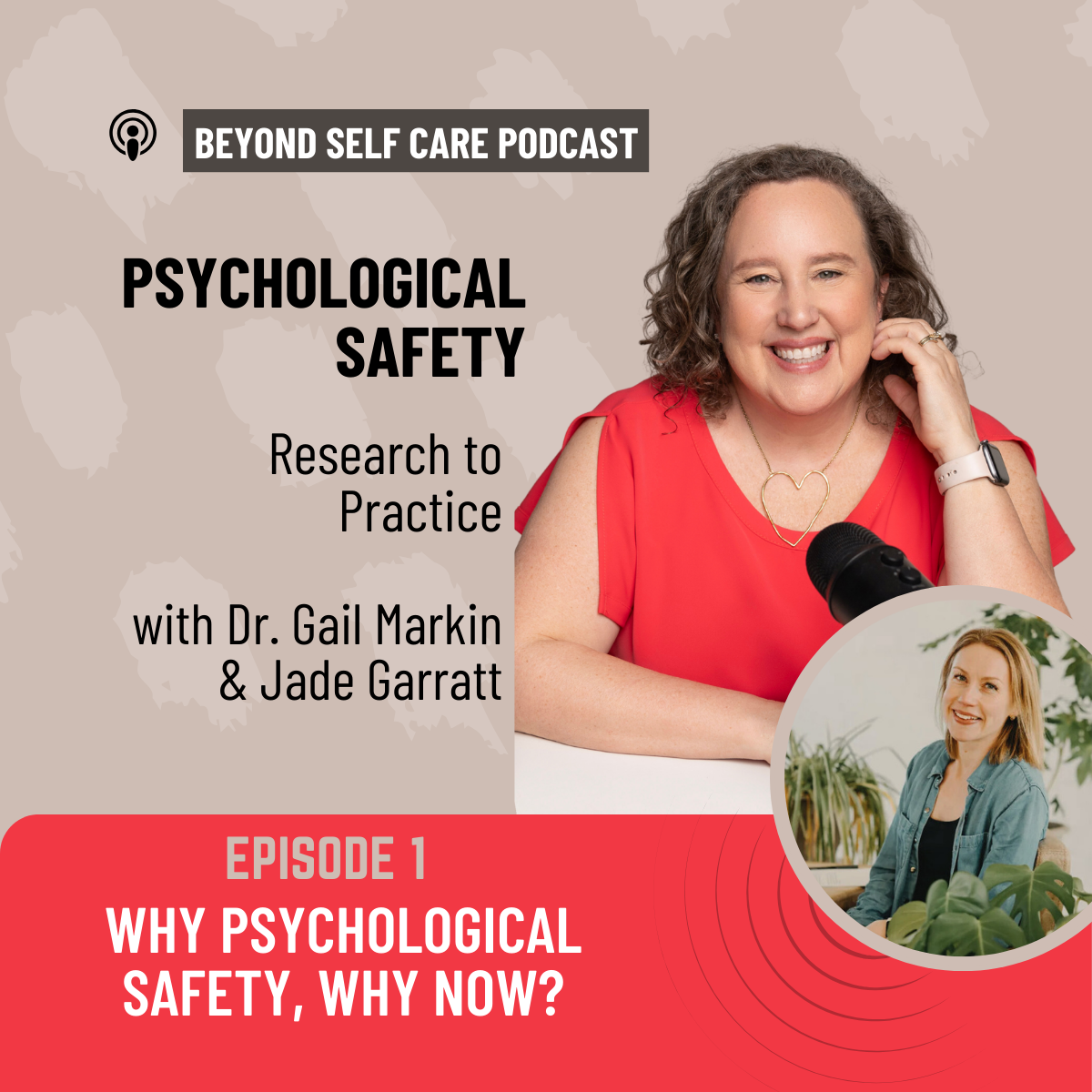
Why Psychological Safety, Why Now?
Psychological Safety: Research to Practice
Listen here.
Subscribe on Apple Podcasts, Amazon Music & Audible or Spotify!
Or subscribe here for an email with each episode!
Introducing Psychological Safety
Psychological safety has become one of the most talked-about concepts in workplaces, schools, and teams. Yet for all the attention it receives, many people still struggle to answer a basic question: What does it actually look like in practice?
In the first episode of this series, Gail Markin and co-host Jade Garratt sets the stage for a season focused on moving psychological safety beyond theory and into lived experience. This conversation invites listeners to slow down, examine assumptions, and explore how trust, openness, and mutual respect are built through everyday behaviours.
Rather than offering a checklist or quick fix, this episode opens a more honest dialogue about what psychological safety requires, what gets in the way, and why it matters now more than ever.
Introducing Jade Garratt, Co-founder, Psych Safety Collective
Jade is a writer, designer, facilitator, and lifelong learner with experience spanning schools, charities, universities, and businesses. As co-founder of the Psych Safety Collective, Jade’s work centers on trust, openness, and mutual respect as the foundations for learning, collaboration, and well-being. Jade is also a Senior Fellow of the Higher Education Academy and brings a deeply reflective, practice-informed perspective to psychological safety.
Key Ideas
Psychological Safety Is Not a Buzzword
One of the clearest messages in this episode is that psychological safety is often misunderstood. It’s not about comfort, niceness, or avoiding challenge. Instead, it is about creating conditions where people feel able to speak up, ask questions, admit uncertainty, and engage honestly without fear of punishment or humiliation. The conversation challenges the idea that psychological safety can be “implemented” through policy or individual efforts alone. Instead, it lives in relationships, power dynamics, and how people respond when something goes wrong.
From Research to Real Life
While psychological safety is grounded in well-established research, translating that research into daily practice is where many organizations struggle. Gail and Jade explore how context matters. What psychological safety looks like in a classroom may differ from a corporate team or a nonprofit, but the underlying principles remain the same: trust, voice, and respect.
The Role of Leadership and Power
Psychological safety does not exist in a vacuum. Power, hierarchy, and leadership behaviour play a defining role in whether people feel safe to contribute. This episode emphasizes that leaders don’t need to have all the answers. In fact, modelling uncertainty, asking for input, and responding constructively to feedback can be far more powerful than projecting confidence.
“A lot of the research looks at [psychological safety] at the team level, but I was really curious about it from a systems perspective.”
Key Takeaways
Learning often requires interpersonal risk-taking, not comfort, but it is not all on the individual to be brave. Set up structures and practices that allow it.
Psychological safety cannot be reduced to a checklist or policy; it is shaped by everyday interactions and intentional ways of working together.
Research matters, but practice is where psychological safety is truly tested.
Responses to feedback or failure are critical signals of safety.
🎧 Listen to the full episode to explore how psychological safety can move from research into everyday reality.
“I didn’t have the language for this at the time, but I knew what it felt like to not be able to show up with your ideas, your questions, your concerns, or your mistakes.”